

(originally published in Spanish)
in 2022, the spanish intelligence agency used the phrase “normalcy is not guaranteed” in an institutional video, published during its 20th anniversary campaign.
that phrase gave me perspective, because ever since then, i’ve understood that normalcy is a fragile, artificial balance sustained by an infrastructure of invisible efforts toward foresight, containment, and maintaining the status quo.
but what happens when we stop calibrating that balance? what happens when the fragile truce against entropy—the one that costs so much to negotiate and maintain—finally snaps? the answer is that the most uncomfortable traits of human nature, like crime, become normalized, or deliberate large-scale destabilization ops, like the covid pandemic, get carried out.
if ever since march 2020 you’ve felt like the world is looking more and more like an open-air asylum run by corrupt officials, criminals, and other victims, you’re not alone.
in this post, i break down how the plot of a psychological horror movie mirrors the mechanics of the collapse of normalcy, and how a chilean psychiatrist proposed the tool that can help us navigate this process as best as possible—which, believe it or not, doesn’t involve quick fixes like becoming a runner or an influencer, or submitting to protestant evangelical cults.
climax
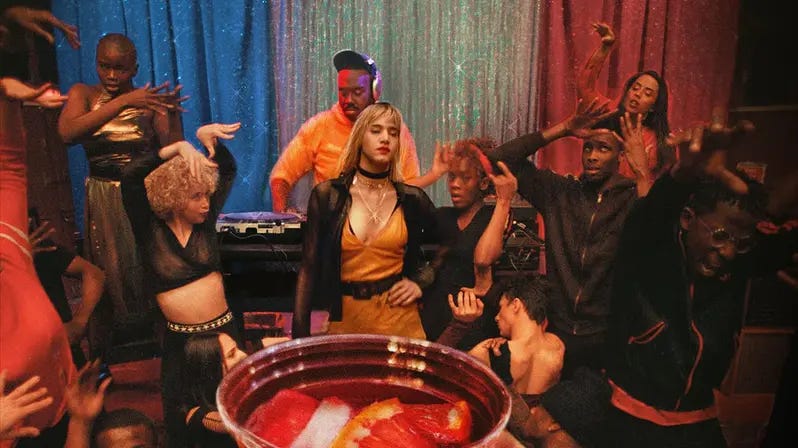
in 2018, film director gaspar noé released climax, a psychological thriller that, in hindsight, feels almost prophetic because it captured the mechanics behind a collective project falling apart due to the malicious infiltration of a devastating force.
the plot, supposedly based on real events in france in the winter of ‘96, revolves around a contemporary dance troupe of about 20 young dancers prepping to represent france at a competition in the US.
for the first half of the movie, noé paints them as talented and genuinely hyped about the trip to new york, especially the female leads, selva and emmanuelle, who seem to be the choreographers running the show.
but right after finishing one of the rehearsals, the afterparty gets out of hand in the worst way possible when they realize someone spiked the sangria koolaid with LSD.
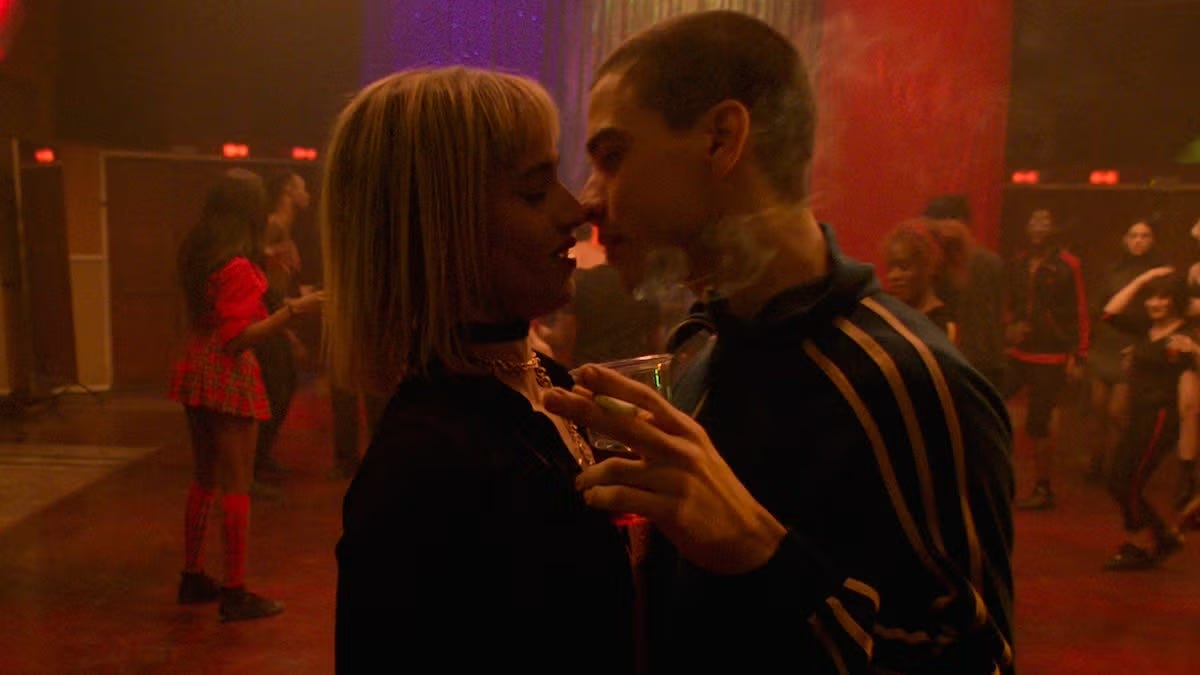
even though noé doesn’t spell it out explicitly, the culprit behind this dirty trick is “psyche,” one of the dancers, who is introduced in the opening scenes as an innocent young german girl who fled berlin because, according to her, “there were too many drugs in the dance scene.”
in the second half of the movie, noé captures the LSD-induced bad trip and collective psychosis, which ends in the death of several characters—including emmanuelle and her 8-year-old son, tito.
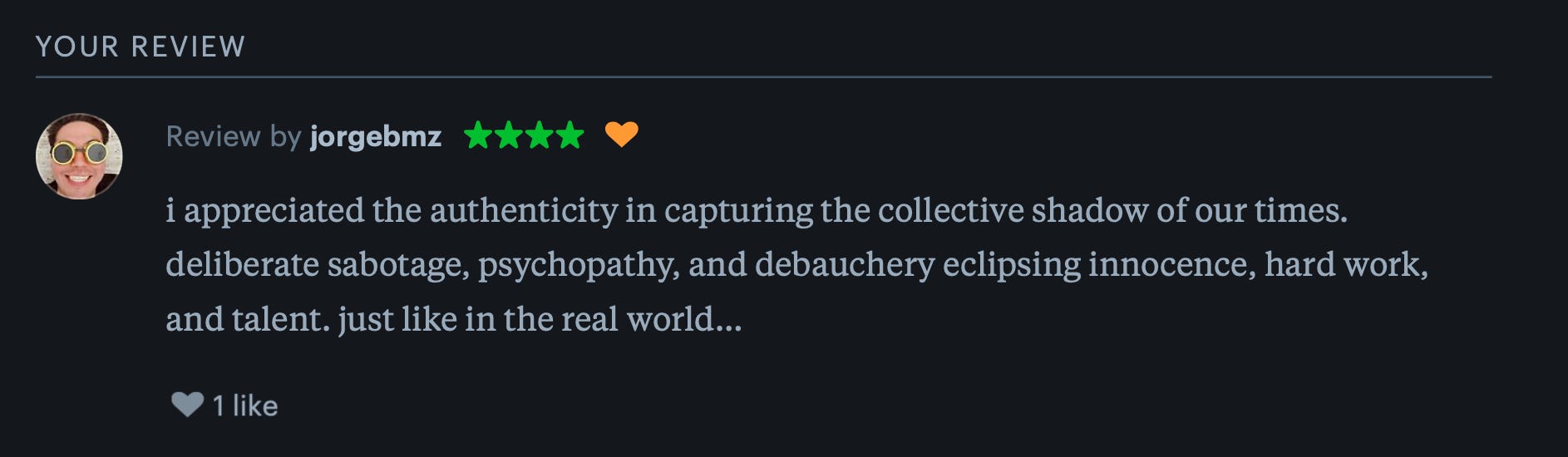
i think living mindfully in 2026 means honestly admitting that someone spiked the sangria koolaid of normalcy with LSD. i also think that denying such a fact gets us nowhere, and playing the blame game doesn’t matter much anymore because it won’t stop the vortex, fix the damage, or help us navigate through it effectively.
in the movie, everyone who drank the koolaid bears some of the responsibility... and even for those who didn’t, this collective mess didn’t care who drank and who refrained.
the only two dancers who skipped the sangria, omar and lou, still suffered the consequences of the LSD: omar gets kicked out into the freezing cold by the mob who accused him of pulling off the trick, eventually freezing to death in the blizzard; and lou, who is pregnant, ends up self-harming and surviving a panic attack after being attacked for the exact same reason as omar. dodging the sangria didn’t shield them from the fallout of the collective bad trip. honestly, i think they suffered even more.
“the sad collapse of the dance troupe in gaspar noé’s climax mirrors the collapse of normalcy that western millennials grew up in: sabotage, psychopathy, narcissism, debauchery, and brainrot infiltrated society to eventually assert dominance over innocence, beauty, the pursuit of excellence, civility, talent, and collaborative spirit.”
in the marketing realm, contrast is often used to leverage the brain’s natural tendency to compare, because clear differentiation cuts through ambiguity and pushes the customer to quickly conclude that one product is superior to another.
it could be that the collapse of normalcy is precisely the painful yet necessary process of contrasting reality, forcing us to rediscover and consciously choose the values we took for granted...
maybe that’s why emerging ideas like limiting smartphone and social media use, reclaiming beauty in contemporary art and design, or the pendulum swing back toward traditional values are starting to take off in the collective unconscious, and maybe the koolaid’s excessive rottenness is the reason they’ll become the norm over the next decade... i can’t say for sure.
what i do know is that it’s far too late to stop the expansion of consciousness that’s already underway—especially in a digital landscape flooded with augmented intelligence.
all survival is fundamentally emotional ☂️
i don’t think there’s a single path, a silver bullet, or much less a universal fix to the problem of the collapse of normalcy, but i do think there are frameworks for navigating it, regardless of whether you drank the sangria or not. it’s like wearing sunglasses and sunscreen on a sunny summer day... it’s not strictly mandatory, and it won’t ever stop the sun from shining, but it can slow down the wear and tear caused by it.
one of those frameworks is the enneagram of passions by the late chilean psychiatrist, claudio benjamín naranjo cohen.
dr. naranjo pushed the idea that society is sick because it’s made up of sick individuals, and that institutions are nothing more than our individual neuroses multiplied and crystallized.
the enneagram of passions merges transpersonal psychology, ancient wisdom, and decades of formal psychiatric research, offering modern people a lens to spot what they deny or ignore in their own personality—the very stuff that shapes the collective shadow.
like i said, learning about the enneagram isn’t a 30-minute quick fix or some buzzfeed quiz... truly internalizing something like this takes multiple in-person group sessions guided by specialized facilitators.
and i won’t lie: those sessions can get pretty uncomfortable for the ego... but discomfort is the essential condition for seeing yourself fully—without romanticized self-delusions. the goal is self-recognition through self-compassion to achieve genuine behavioral transformation.
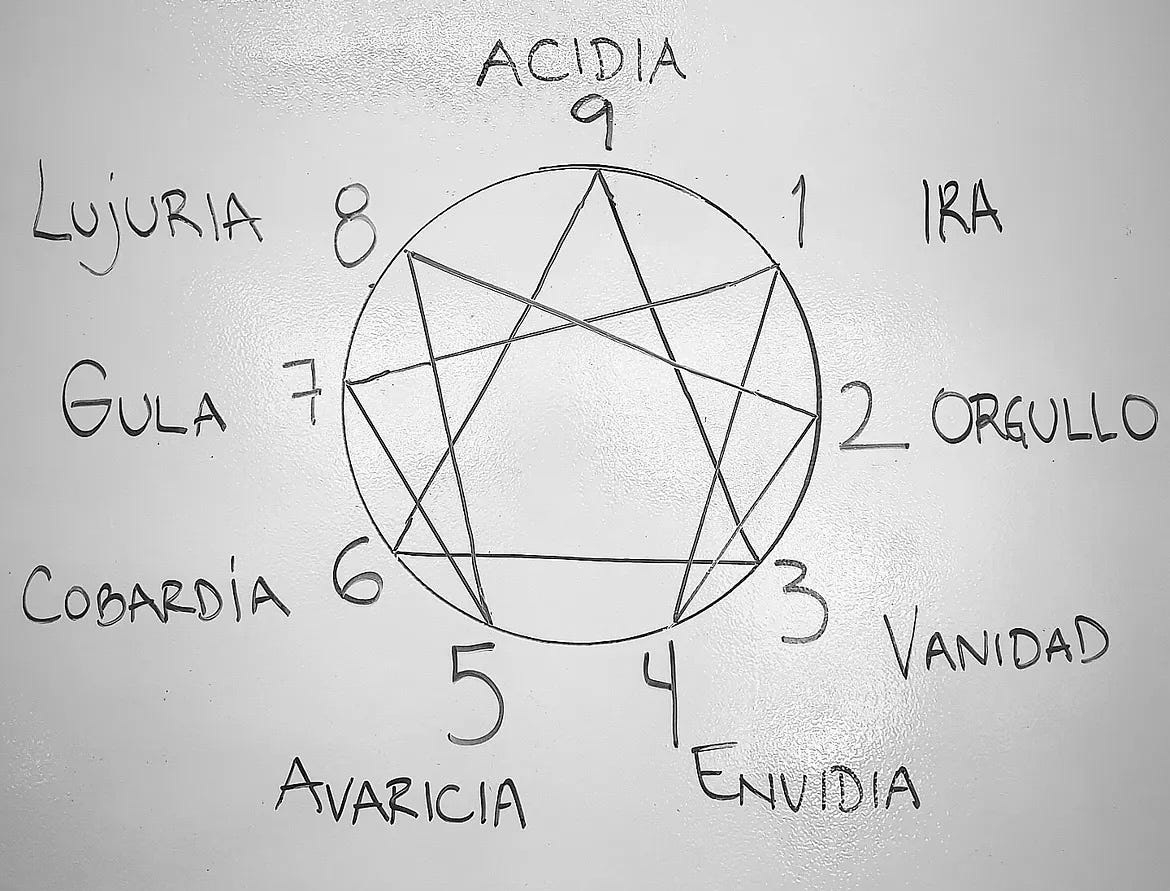
dr. naranjo suggests that every personality is formed around one of the 9 deadly sins, which a person clings to by default to avoid existential dread or the fear of death at all costs.
his theory holds that during the first 5 years of life, the person realizes they’re completely dependent on their parents, inevitably developing a natural attachment rooted in the fear of being left without that safety net. as they grow and face life’s challenges, the identity built on that survival attachment becomes the blueprint upon which they project, build, and break emotional bonds with the world.
when existential crises hit, the person senses deep down that the identity that once kept them alive doesn’t serve them anymore... and that’s precisely the point in life where the work of decoding your internal emotional wiring begins—not to tear it out overnight, but to clean it up, organize it, and gradually build new outcomes out of new behaviors.
there are nine deadly sins, not seven
at a systemic level, these sins or passions act as the emotional engine driving collective degradation. according to naranjo:
anger manifests as moral puritanism that constantly needs to correct others to evade its own flaws.
pride generates patronizing saviorism to rack up emotional debt and exert control.
vanity reduces an individual’s worth down to metrics, output, and personal brand.
envy fuels social resentment through constant comparison and perpetual grievance.
greed drives defensive hoarding and intellectual isolation out of fear of depletion.
cowardice upholds authoritarianism in exchange for rigid certainty against ambiguity.
gluttony pushes hedonism and overstimulation to numb the void and dodge commitment.
lust validates violence, excess, and extractivism as legitimate tools to gain power over others.
sloth or psychic apathy traps the masses in an inertia of conformity and the surrender of critical thinking.
but why are there 9 sins, if catholic doctrine (and general pop culture) says there are only 7? well, because rather than a provable theory, this specific framing is more of a plausible intuition—like everything else in the realm of the human psyche.
by cutting out pride and cowardice as sins, it became easy to justify behaviors that sustained a fragile, artificial equilibrium for centuries. dropping those 2 sins in particular allowed the ruling institution to run patronizing social safety nets to accumulate emotional debt and control over individuals who were all too willing to uphold authoritarianism in exchange for rigid certainty in the face of uncertainty.
this dynamic was a clear win-win situation for both the institution and the masses for centuries... but i suspect it’s going to demand way more emotional and intellectual honesty from both sides if it is to keep evolving…
i also think the enneagram clearly highlights the deadly sins modern western societies are built on: vanity, envy, greed, sloth, lust, and gluttony are the bread and butter of global capitalism...they are basically 9 different flavors of narcissism, and individuals have had to pick at least one just to survive in society (up until now, at least).
“the old world is dying, and the new world struggles to be born: now is the time of monsters.” ― antonio gramsci
that quote from philosopher antonio gramsci hits the nail on the head for 2026... the monsters are out in the wild because the search for a new win-win dynamic between power and the masses is far from over.
that’s why strengthening your cognitive security is crucial to riding out the sangria bad trip—and that comes easier to anyone who knows their core passion attachment or has acknowledged their own part in the collective collapse of normalcy…tbh i don’t know when this transition period will come to an end, but what i do know is that now is the time to imagine a future where survival won’t require getting hooked on one of the 9 capital sins.
la normalidad no está garantizada © 2026 by Jorge C. Barrios M. is licensed under Creative Commons Attribution-NonCommercial-ShareAlike 4.0 International